What is Isomerism – Types

Introduction
Isomerism is a fundamental concept in chemistry that describes the existence of two or more compounds having the same molecular formula but different arrangements of atoms. These compounds, known as isomers, can exhibit significantly different physical, chemical, and biological properties despite containing the same number and types of atoms. The study of isomerism is essential for understanding molecular structure, reactivity, and stereochemistry.
What is Isomerism?
Isomerism is the phenomenon in which compounds possess the same molecular formula but differ in the arrangement of atoms or the spatial orientation of those atoms in space.
For example, both ethanol (C₂H₆O) and dimethyl ether (C₂H₆O) have the same molecular formula, yet they have different structures and properties. Therefore, they are structural isomers.
Classification of Isomerism
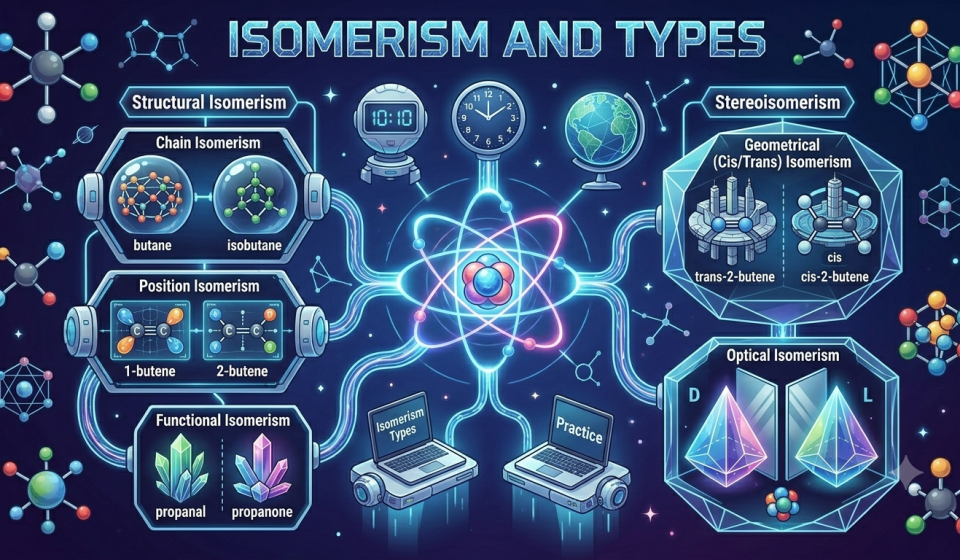
Isomerism is broadly divided into two main categories:
1. Structural (Constitutional) Isomerism
Structural isomers have the same molecular formula but differ in the connectivity or sequence of bonding between atoms.
Types of Structural Isomerism
a) Chain Isomerism
Chain isomerism occurs when compounds differ in the arrangement of the carbon skeleton.
Example:
- n-Butane (CH₃–CH₂–CH₂–CH₃)
- Isobutane (2-methylpropane)
Both have the molecular formula C₄H₁₀ but different carbon chain arrangements.
b) Position Isomerism
Position isomerism arises when the functional group, substituent, or multiple bond occupies different positions on the same carbon skeleton.
Example:
- 1-Propanol
- 2-Propanol
Both possess the formula C₃H₈O but differ in the position of the hydroxyl group.
c) Functional Group Isomerism
Functional group isomers have the same molecular formula but different functional groups.
Example:
- Ethanol (Alcohol)
- Dimethyl ether (Ether)
Both have the formula C₂H₆O.
d) Metamerism
Metamerism occurs when different alkyl groups are attached on either side of a polyvalent functional group such as oxygen, sulfur, or nitrogen.
Example:
- Ethoxyethane
- Methoxypropane
Both are ethers with the molecular formula C₄H₁₀O.
e) Ring-Chain Isomerism
Ring-chain isomerism exists between cyclic and open-chain compounds.
Example:
- Propene
- Cyclopropane
Both have the molecular formula C₃H₆.
f) Tautomerism
Tautomerism is a dynamic form of isomerism involving the rapid interconversion of two structural isomers through the migration of a proton and a double bond.
Example:
- Keto form
- Enol form
This phenomenon is known as keto-enol tautomerism.
2. Stereoisomerism
Stereoisomers have the same molecular formula and connectivity of atoms but differ in their three-dimensional arrangement in space.
Types of Stereoisomerism
a) Geometrical Isomerism
Geometrical isomerism results from restricted rotation around a double bond or within a ring structure.
Cis-Trans Isomerism
Cis Isomer: Similar groups are on the same side.
Trans Isomer: Similar groups are on opposite sides.
Example:
- Cis-2-butene
- Trans-2-butene
E/Z Isomerism
For more complex alkenes, the Cahn–Ingold–Prelog priority rules are used.
- E (Entgegen): Higher priority groups are opposite.
- Z (Zusammen): Higher priority groups are on the same side.
b) Optical Isomerism
Optical isomerism occurs in chiral molecules that exist as non-superimposable mirror images.
Enantiomers
- Mirror-image stereoisomers.
- Rotate plane-polarized light in opposite directions.
- Often show different biological activities.
Example:
- (R)-Lactic acid
- (S)-Lactic acid
Diastereomers
- Stereoisomers that are not mirror images.
- Possess different physical and chemical properties.
Example:
- D-glucose and D-mannose
c) Conformational Isomerism
Conformational isomerism arises due to rotation around single (σ) bonds.
Examples:
- Staggered and eclipsed ethane
- Anti and gauche butane conformations
- Chair and boat cyclohexane conformations
Summary Table
| Type | Definition | Example |
|---|---|---|
| Chain Isomerism | Different carbon skeleton | n-Butane, Isobutane |
| Position Isomerism | Different position of functional group | 1-Propanol, 2-Propanol |
| Functional Isomerism | Different functional groups | Ethanol, Dimethyl ether |
| Metamerism | Different alkyl groups around polyvalent atom | Ethoxyethane, Methoxypropane |
| Ring-Chain Isomerism | Cyclic vs open-chain structure | Cyclopropane, Propene |
| Tautomerism | Dynamic proton shift | Keto-Enol forms |
| Geometrical Isomerism | Different arrangement around double bond | Cis/Trans-2-butene |
| Optical Isomerism | Non-superimposable mirror images | Enantiomers |
| Conformational Isomerism | Rotation about single bonds | Staggered/Eclipsed ethane |
