

Optical Activity, Types, Conditions, Measurement

Optical activity is the property of a substance to rotate the plane of plane-polarized light when the light passes through it. Why does it happen? Optical activity occurs because the molecule is chiral—it has a non-superimposable mirror image, just like…
Easy Trick to Remember Chiral vs Achiral Molecules
Hand Trick (Best Memory Aid) Look at your left and right hands. This is exactly what a chiral molecule is. Chiral = Like Hands Example: 🪞 Mirror Trick Ask two questions: 🔍 Symmetry Rule (Most Useful in Exams) If a molecule has an internal plane of…
Difference Between Conformational and Configurational Isomerism
Both conformational and configurational isomerism are types of stereoisomerism, but they differ in how the isomers interconvert. Feature Conformational Isomerism Configurational Isomerism Definition Isomers differ due to rotation around single (σ) bonds.…
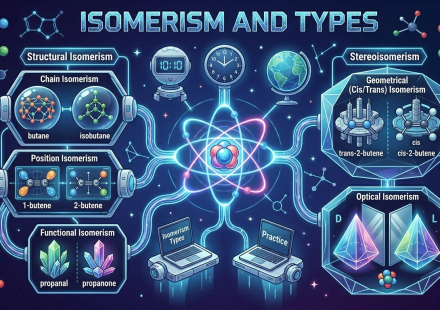
What is Isomerism – Types
Introduction Isomerism is a fundamental concept in chemistry that describes the existence of two or more compounds having the same molecular formula but different arrangements of atoms. These compounds, known as isomers, can exhibit significantly…
Fundamentals of Stereochemistry
What is Stereochemistry? Stereochemistry is the branch of chemistry that studies the three-dimensional arrangement of atoms in molecules and how this spatial arrangement influences their physical, chemical, and biological properties. While two compounds…