Skip to content
-
Subscribe to our newsletter & never miss our best posts. Subscribe Now!
Chemophilic.com Chemophilic.com

Explore Reactions, Understand Mechanisms, Discover Innovation

Chemophilic.com Chemophilic.com

Explore Reactions, Understand Mechanisms, Discover Innovation

  • Home
  • Organic Chemistry
    • Mechanism
    • Reactions
  • AI Stoichiometry
  • List of Reactions
  • Stereochemistry
    • Fundamentals of Stereochemistry
    • Stereochemical Nomenclature
    • Isomerism
    • Molecular Representations
    • Conformational Analysis
    • Chirality and Optical Activity
  • Home
  • Organic Chemistry
    • Mechanism
    • Reactions
  • AI Stoichiometry
  • List of Reactions
  • Stereochemistry
    • Fundamentals of Stereochemistry
    • Stereochemical Nomenclature
    • Isomerism
    • Molecular Representations
    • Conformational Analysis
    • Chirality and Optical Activity
Close

Search

Subscribe
Chirality and Optical ActivityFundamentals of StereochemistryStereochemistry

Optical Activity, Types, Conditions, Measurement

By Fawad Chaudhry
June 22, 2026 1 Min Read
0

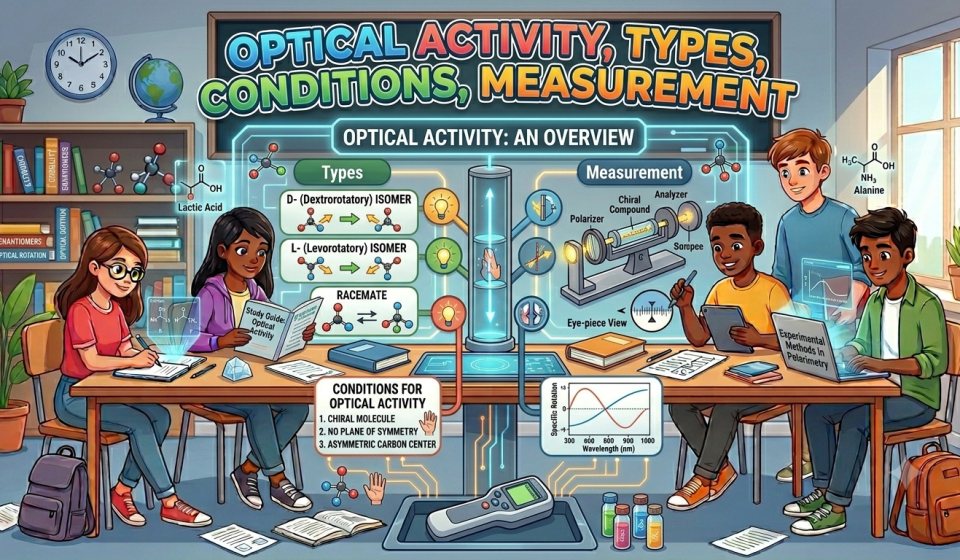
Optical activity is the property of a substance to rotate the plane of plane-polarized light when the light passes through it.

Why does it happen?

Optical activity occurs because the molecule is chiral—it has a non-superimposable mirror image, just like your left and right hands.

Types of Optical Activity

  1. Dextrorotatory (+ or d)
    • Rotates plane-polarized light to the right (clockwise).
    • Example: (+)-glucose.
  2. Levorotatory (− or l)
    • Rotates plane-polarized light to the left (counterclockwise).
    • Example: (−)-fructose.

Conditions for Optical Activity

A molecule is usually optically active if:

  • It contains at least one chiral (asymmetric) carbon atom attached to four different groups.
  • It lacks an internal plane of symmetry.

Examples

Optically Active

  • Lactic acid: CH₃–CH(OH)–COOH
  • 2-Butanol: CH₃–CH(OH)–CH₂CH₃

Optically Inactive

  • Methane (CH₄)
  • 2-Propanol (CH₃–CHOH–CH₃)
  • Meso compounds (contain chiral centers but have internal symmetry)

Measurement

Optical activity is measured using a polarimeter.

The observed rotation (α) is related to concentration and path length by:[α]=αlc[\alpha] = \frac{\alpha}{lc}[α]=lcα​

where:

  • [α] = specific rotation
  • α = observed rotation (degrees)
  • l = path length (dm)
  • c = concentration (g mL⁻¹)

Tags:

DextroOptical ActivitypolarimeterRotatory
Author

Fawad Chaudhry

Fawad is a researcher and science communicator with a strong academic background in chemistry, specializing in organic synthesis, medicinal chemistry, computational chemistry, and molecular docking studies. His research interests focus on the design, synthesis, and biological evaluation of heterocyclic and conjugated arylated compounds, particularly for anticancer and antimicrobial applications. He has worked extensively with molecular modeling and protein–ligand interaction studies, utilizing computational tools to investigate binding affinities, ADME properties, and structure–activity relationships. His recent research has involved docking studies against important biological targets, including dihydrofolate reductase (DHFR), to explore potential therapeutic candidates. In addition to his research activities, Fawad is passionate about chemistry education and scientific outreach. He is developing educational resources and online platforms dedicated to organic chemistry, stereochemistry, named reactions, reaction mechanisms, and computational chemistry concepts. Through these initiatives, he aims to make complex chemical concepts accessible to students, researchers, and professionals worldwide. His areas of expertise include organic reaction mechanisms, stereochemistry, medicinal chemistry, molecular docking, drug discovery, ADME analysis, computational chemistry, and scientific writing. He is also actively engaged in creating chemistry-focused digital content and educational materials for the global scientific community. Driven by curiosity and innovation, Fawad continues to explore the intersection of synthetic chemistry and computational drug design to contribute to the development of novel therapeutic agents and advance chemical education.

Follow Me
Other Articles
Previous

Easy Trick to Remember Chiral vs Achiral Molecules

Next

Newman Projection, Significance and Conformations

No Comment! Be the first one.

Leave a Reply Cancel reply

Your email address will not be published. Required fields are marked *

  • A–Z Organic Chemical Reactions: Complete List of Important Name Reactions
  • About Me
  • AI Integrated Computation
  • AI Integrated Suzuki Coupling Stoichiometric Calculator
  • Molar masses, limiting reagents, theoretical & percent yield for common organic reactions
  • Privacy Policy
  • Register
  • Stoichiometry Calculator for Organic Synthesis
  • Welcome to Chemophilic
Copyright 2026 — Chemophilic.com. All rights reserved. Blogsy WordPress Theme