
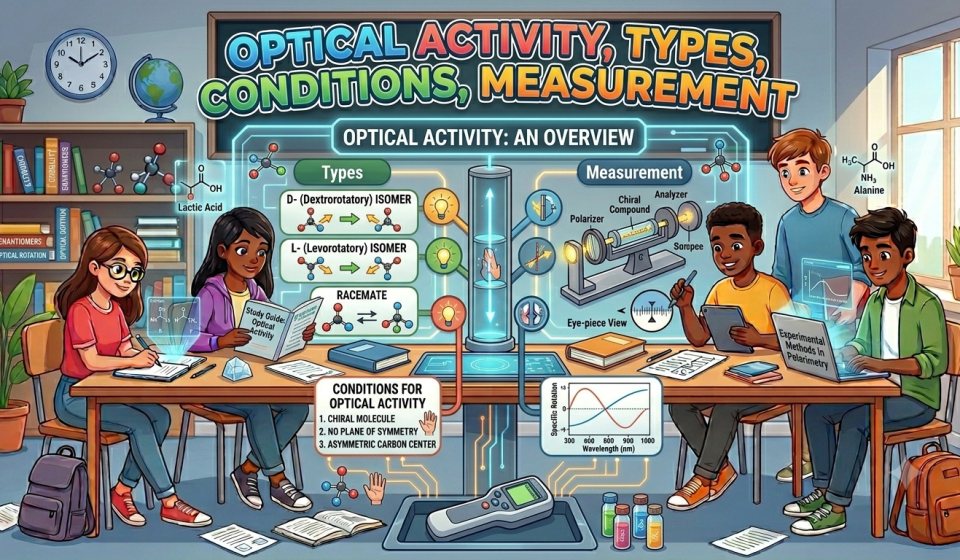
Optical Activity, Types, Conditions, Measurement

Optical activity is the property of a substance to rotate the plane of plane-polarized light when the light passes through it.
Why does it happen?
Optical activity occurs because the molecule is chiral—it has a non-superimposable mirror image, just like your left and right hands.
Types of Optical Activity
- Dextrorotatory (+ or d)
- Rotates plane-polarized light to the right (clockwise).
- Example: (+)-glucose.
- Levorotatory (− or l)
- Rotates plane-polarized light to the left (counterclockwise).
- Example: (−)-fructose.
Conditions for Optical Activity
A molecule is usually optically active if:
- It contains at least one chiral (asymmetric) carbon atom attached to four different groups.
- It lacks an internal plane of symmetry.
Examples
Optically Active
- Lactic acid: CH₃–CH(OH)–COOH
- 2-Butanol: CH₃–CH(OH)–CH₂CH₃
Optically Inactive
- Methane (CH₄)
- 2-Propanol (CH₃–CHOH–CH₃)
- Meso compounds (contain chiral centers but have internal symmetry)
Measurement
Optical activity is measured using a polarimeter.
The observed rotation (α) is related to concentration and path length by:[α]=lcα
where:
- [α] = specific rotation
- α = observed rotation (degrees)
- l = path length (dm)
- c = concentration (g mL⁻¹)
